FIG. I · ADAPTORCHA RECORD YOU CAN REVIEW
FOR DEVELOPERS REVIEWING AI CHANGES

Review AI-generated code with a record of what actually ran.

Bring the change explanation from your AI, your goal and what you already checked. Get the questions to investigate before you trust the change.

AdaptOrch is a hosted review layer for AI coding agents. It records what ran, which checks were available and what still needs human review. MCP connects your tools; repository checks need a separately configured execution environment.

Starter is free with 50 admitted runs a month. Pro adds 500 runs and 5 workspace users. Model usage is billed through your own provider key. Code checks need a separately configured execution environment.

EXECUTION REPORTILLUSTRATIVE SAMPLE

The work behind “done”.

run_example_001EXECUTION ≠ VERIFICATION
EXAMPLE PATH
Hosted record · no code checks
MODEL
Your chosen provider and model
CODE CHECKS
Not run in this example
REVIEW NEEDED

No command evidence is recorded in this example. Inspect the output before deciding the next check.

Report layout example, not a customer run. Completion and code verification are separate facts.

Open the report example →

AI-generated illustration

FIG. I-B / RUN EXPLORERINTERACTIVE SAMPLE / NO CODE IS EXECUTED

Your AI says it works. See what ran.

The answer is only part of the story. Follow your agent’s work, inspect the checks that were available, and see what still needs your attention.

Select a node to inspect its record.

No sign-up for this demo. No code is executed.

RUN EXPLORERILLUSTRATIVE SAMPLE

One run. An inspectable path.

Choose a scenario. Then follow the evidence.

NODE RECORD / 06Review needed

Your report

Review the unrelated configuration change and the check that did not run. No merge or selection is performed.

Simulated playback / configured-runner example / not a customer result

Keep your agent.See the record.Make the call.

A review layer, not another coding agent.

FIG. II · REVIEW THE RECORDILLUSTRATIVE · CONFIGURED VALIDATION EXAMPLE

Know what ran. Know what to review next.

Start with the questions you already ask in a PR review. A run report connects the recorded inputs, results and remaining review work.

  1. 01

    What ran?

    Start with the recorded inputs, selected model and output. Separate the execution state from the evidence for the change.

  2. 02

    What was checked?

    Read the commands, targets and results that actually exist. A skipped or missing check is never a passing check.

  3. 03

    What needs review?

    See the open scope questions and missing checks. Decide what to inspect, configure or run next.

EXAMPLE REPORTILLUSTRATIVE, NOT CUSTOMER DATA
RECORDED FIELDS · EXAMPLE VALUES
CHANGED3 files · +41 / -4src/table.py+18 −4tests/test_io.py+19 −0config/prod.yaml+4 −0 · outside stated scope
CHECKEDReproduction before changeFAILSame check after changePASSDeployment integration checkNOT RUN
RULE FINDING · EXAMPLE

A configuration file changed outside the declared scope. The integration check has not run.

AI EXPLANATION · ILLUSTRATIVE, NOT EXECUTION EVIDENCE

Ask whether the configuration change belongs in this patch, and decide which integration check is needed.

REVIEWHuman review required

A real report covers the checks that ran, not untested behavior. This example did not execute customer code.

Technical boundarycorrectness_claim: false

Set up your first hosted run

Choose MCP, CLI or Python SDK, then sign in for the setup guide. Configure an AdaptOrch key, your provider key and model before submitting a task.

Choose a connection method

The report above is illustrative. Hosted command checks are off by default; repository checks need a separately configured execution environment.

III · YOUR WORK SURFACETHREE INTERFACES · EXPLICIT BOUNDARIES

Start where you work.

Connect from your agent, terminal or Python workflow. Each route leads to the same hosted execution records, with its own setup instructions.

AGENT CLIENT · HOSTED MCP

Keep your agent. Add a reviewable record.

Connect an HTTP-capable MCP client to AdaptOrch. Submit a bounded run, then inspect the returned record and available artifacts.

Set up MCP

HOSTED ENDPOINT

https://adaptorch.com/mcp

An AdaptOrch API key authenticates the service. Your provider key and selected model configure model execution; provider charges are separate.

TERMINAL · HOSTED CLIENT

Review runs from your terminal.

Use the hosted CLI client to work with run records from your terminal. Follow the setup guide for installation and supported commands.

Set up the CLI

TERMINAL SETUP PATH

  1. 01

    Authenticate with AdaptOrch

  2. 02

    Configure your provider and model

  3. 03

    Submit once. Inspect the returned record.

The CLI needs service authentication and request-scoped provider configuration. Follow the guide for installation and supported commands.

PYTHON · HOSTED CLIENT

Bring execution records into your code.

Use the hosted Python client to submit bounded work and inspect the resulting records. Follow the guide for supported methods and request fields.

Set up the Python SDK

PYTHON SETUP PATH

  1. 01

    Authenticate with AdaptOrch

  2. 02

    Configure your provider and model

  3. 03

    Submit once. Inspect the returned record.

The Python client uses service authentication and request-scoped BYOK. A successful request does not establish that code checks ran.

Choose the interface first. Configure the execution scope separately. Hosted command verification is disabled by default; a local client is not a self-hosted service.

Works beside the tools you already use

  • Cursor
  • Claude Code by Anthropic
  • GitHub
  • GitHub Actions
  • Docker

Compatible workflow surfaces; logos are not endorsements.

  • CONNECTS TOhosted API
  • YOUR KEYBYOK
  • WORKS WITHyour coding agent
  • RAW DATApublished
FIG. IV · TWO WAYS TO STARTONE REVIEW WORKFLOW · DIFFERENT EXECUTION BOUNDARIES

Start with the record. Add the checks your environment supports.

AVAILABLE HOSTED PATH

Connect your agent. Review its runs.

Use MCP or the API to submit model-backed work and retrieve run records, outputs and available artifacts. Starter is a free hosted plan.

  • Authenticate with an AdaptOrch API key.
  • Use your own provider credentials for model calls.
  • Shared hosted command verification is disabled by default.
Start free hosted

SEPARATE SETUP / SCOPED POC

Check changes in an agreed execution environment.

For repository and command checks, agree the environment, repository access, test commands and evidence handling first. A hosted plan upgrade does not enable this automatically.

  • Define access, isolation and network permissions.
  • Review available check results and unclassified failures.
  • Agree setup, operating costs and the decision criteria.
Discuss repository validation

BYOK is a billing and credential arrangement, not a promise that code stays on your device. Read the data-flow summary before sending inputs.

Data, security and operating responsibilities →

Illustrative interactive example. No customer code or model call is executed by this button.

FIG. V · REVIEW WALKTHROUGH interactive example · apply → classify → review

See an illustrative review process.

Choose an example scenario and replay the displayed steps. The demonstration uses fixed example data.

WHAT THE AI DID Candidate patch modifies astropy/table.py to repair issue behavior.
  1. RUN ITDocker harness apply: pass
  2. LIST THE CHANGESRealized git diff generated
  3. CHECK ITFlagged: repaired, but never reproduced
VERDICT Needs Review

The patch applies cleanly, but we cannot call it correct. The test evidence came back inconclusive, and the shadow check flagged repair risk with no reproducible run behind it.

Static example. Select Replay to step through the record.

FIG. V-A / COST TRAILUSD / SAMPLE DATA

The path matters. So does the cost.

A retry is still work. This sample keeps every attempt in view, and an unreported cost never becomes a zero.

Platform plan and model-provider charges are separate.

KNOWN ESTIMATED SUBTOTALILLUSTRATIVE SAMPLE
$0.0127+ 1 unreported call
6 calls, 2 attempts, 3,500 tokens reported
Sample model calls by attempt
CALLATTEMPTSAMPLE ESTIMATE
Draft01$0.0048
Review01$0.0021
Summary01$0.0005
Draft02$0.0048
Review02Unreported
Summary02$0.0005

Earlier attempts stay in the record.

Illustrative model-call amounts in USD, not live prices, a bill, or a savings claim. Unreported calls are excluded from the subtotal, never treated as free.

FIG. VI · PACKAGING shadow evidence → PR preflight

Choose the capacity your review workflow needs.

All three plans below are hosted service plans. Start with records, then choose the run allowance and workspace-user capacity you need.

Bring your own key (BYOK) is required on every plan for model execution. Your subscription covers the listed service allowance; your provider bills model usage separately. An AdaptOrch key authenticates the service, not the model provider.

Optional ensemble fan-out calls 2–5 of your own models in a configured run. One admitted run uses one call from your plan quota; your provider bills the tokens for every member. Provider cost depends on the models, tokens and attempts. Workspace users are people, not ensemble model members. Agreement is not an accuracy guarantee.

Model outputs and AI-written explanations are AI-generated and require human review. They are not the same evidence as execution logs or results from checks that actually ran.

PLAN POSITIONING MONTHLY INCLUDES ACTION
01STARTER Connect and inspect your first records $0/month Hosted API access; your provider key 50 admitted runs/month · 1 workspace user Run records and available artifacts Start free →
03TEAM Review records in a shared workspace $149/month 2,500 admitted runs/month · 15 workspace users Shared workspace capacity Configured dashboard access Discuss a separate repository-validation scope Choose Team →
04PRIVATE RUNNER / POC Repository validation / private environment Directcontract Evaluation period agreed after feasibility review Starting discussion: 1–3 repositories · 30–100 candidates Case-level reports and unclassified failures Compare useful findings and operating effort Discuss PoC →

Annual amounts are the full yearly charge in USD, not a monthly bill. Pro: $421.20/year ($35.10/month equivalent). Team: $1,609.20/year ($134.10/month equivalent). Starter has no annual discount.

Hosted plans do not automatically apply or merge repository changes. Separately configured checks may apply a candidate in an agreed workspace. Human review and the recorded execution boundaries remain explicit.

What counts as a run?

The monthly allowance counts admitted runs, not status or artifact reads. It is used at admission rather than at SUCCEEDED. Internal attempts remain in that run; a separately admitted rerun counts again. Provider billing is independent.

What needs separate setup?

Repository command checks need a separately configured execution environment. A Pro or Team upgrade does not turn hosted command verification on; setup and execution-environment costs are agreed separately.

Estimate monthly break-even Your assumptions · not measured savings

What would need to change to break even?

Economics · ESTIMATE ONLY. Compare a monthly hosted subscription with self-hosting under your own labor and cost assumptions. No savings have been measured.

Your monthly assumptions

Enter only additional provider spend relative to your self-host baseline. Enter 0 explicitly if there is none; a blank is not zero.

These fields stay in your browser. They are not submitted or saved by this calculator.

Required reduction, not time saved

Loading current monthly plan prices…

Monthly subscription (USD)
—
Required MONTHLY labor-time reduction (minutes)
—

max(0, subscription + extra_provider - self_host_infra) / hourly * 60

subscription, extra_provider and self_host_infra are monthly USD amounts; hourly is your labor value in USD per hour. The result is minutes per month, floored at zero.

This is the labor-time reduction required each month to break even on these inputs, NOT measured saved time or full TCO. We do not recommend plans from hours or PR counts.

Uses current monthly USD prices, not annual promotions. Taxes and BYOK costs shared by both workflows are excluded. Setup and ongoing maintenance are not fully included; actual total cost may differ.

More about the review workflowUse cases · product preview · review questions
FIG. II · TWO USERS one execution record

Four problems a completion report can miss.

A review record helps you ask the next question: was the scope right, did the check run, did a test change, or did the execution environment fail?

FOR ENGINEERING TEAMS

Stop reviewing runner noise

Separate code failures from install, network, and runner failures before CI and review time disappear.

See the execution trail →
FOR SOLO BUILDERS

Know whether the AI patch is ready

Read Pass, Needs review, or Block without understanding every line. Send the receipt back to your coding agent as fix context.

PASSRan in a clean environment BLOCKAction and fix context required
FIG. II-B · PRODUCT PREVIEW connect → run → receipt

From an agent run to a record you can inspect.

Open run history to review status, model attribution and available artifacts. Repository checks require a separate configured execution path.

  1. 01Connect your existing agent through MCP or the API.
  2. 02Submit a run with BYOK, or configure a separate validation environment.
  3. 03Inspect the record and any check results that were actually produced.
View the illustrative review process →
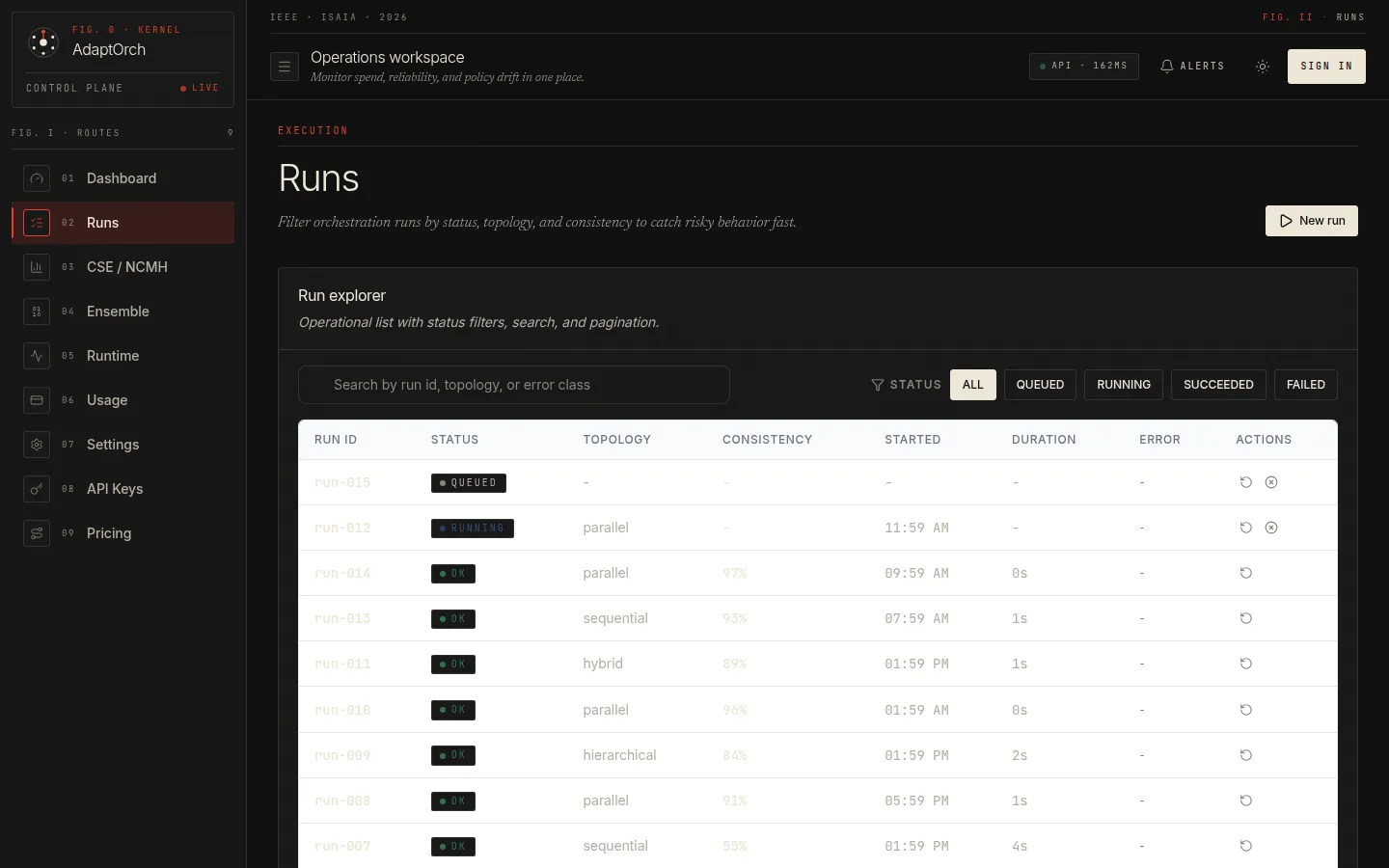
Illustrative AdaptOrch run-history interface
Interface example · illustrative data, not a customer outcome
How configured validation worksEnvironment · checks · retained records

Set the boundaries of a separate execution environment.

A repository check depends on the selected environment and commands. Agree file access, network permissions and isolation before execution. Compare recorded results with CI; a pass in one environment is not a guarantee in another.

Temporary workspaces and retained reports are different data. Cleanup follows the runner configuration; execution records, logs and artifacts follow the documented retention policy.

Read the execution and evidence boundaries →
FIG. IV · REVIEW QUESTIONS scope · checks · open items

Four things a completion report can leave unanswered.

Use the available execution evidence to decide what needs another look. These are review questions, not claims that every run detects every problem.

  1. #01“I FIXED IT”

    Was the bug reproduced?

    A before/after reproduction makes a fix easier to evaluate. If it is missing, name the other evidence and the behavior that still needs checking.

  2. #02“ONE FILE”

    Did the scope change?

    Compare recorded files and changes with the declared task scope. A configured validation path can make unrelated edits visible.

  3. #03“ALL GREEN”

    Did the check itself change?

    A removed or weakened test can change what a passing result means. Review test changes alongside the command outcome.

  4. #04“YOUR BUG”

    Did the code run at all?

    Review setup, network and test outcomes separately. Missing commands and timeouts can be classified, while ambiguous failures still need diagnosis.

Research and measurement notes Scoped experiments, raw data, misses and limitations

Research, methods and limits

These results concern their stated experiments. Read positive results, misses and methodological limits together; they are not a promise about customer repositories.

The AdaptOrch research paper studies task-adaptive multi-agent orchestration. The hosted product and the CEK repository-validation workflow have their own execution limits; paper results do not establish customer code correctness or hosted performance.

Read the AdaptOrch paper on arXiv →

AdaptOrch: Task-Adaptive Multi-Agent Orchestration in the Era of LLM Performance Convergence · Geunbin Yu · submitted 2026-02-18

Paper (A)
    Verified (C)
      30 synthetic ledger tasks · one run per arm Download the evidence JSON

      Improvement and regression counts are available in the evidence JSON.

      Every square is one recorded synthetic task. Green marks a passed check; a red outline marks an outcome that regressed from A to C.

      Synthetic ledger, 30 tasks: paper baseline A versus robust + verifier C. Eight outcomes improved and one regressed. Both synthesis and verification differ; this is not a verifier-only comparison.

      Customer value: what the evidence can tell us.

      Local execution is measured. Human time savings are not. Keep those findings separate from an assumption-based cost estimate.

      Local command checks · MEASURED

      This experiment times CommandVerifier construction, execution and classification using trusted local controls, with no model API calls. It does not verify actual AI-generated patches.

      Loading local measurement data…

      Download all attempts (JSON) →
      Recorded attempts
      —
      Fixed controls
      —
      Repeats per control
      —
      Mismatched attempts
      —
      Recorded at
      —
      Source revision
      —

      Five fixed synthetic controls, repeated locally. Repetitions are not independent developers or tasks. Matches are counts of expected classifications, NOT bug-detection accuracy. Scroll the table horizontally if needed; keyboard users can focus it and use arrow keys.

      Local control outcomes and wall-clock timing
      Control Expected class Observed classes (counts) Median (milliseconds) p95 (milliseconds) Matches / attempts (counts)
      Passing assertionClassification mismatch — — — — —
      Failing assertionClassification mismatch — — — — —
      Missing executableClassification mismatch — — — — —
      Deliberate timeoutClassification mismatch — — — — —
      Missing Python dependencyClassification mismatch — — — — —

      Known limitation: the missing Python dependency was misclassified as an ordinary test failure. The classifier does not distinguish all environment failures from candidate failures.

      These are not hosted round-trip latency measurements, a security-isolation test, or actual AI patch verification. Shared hosted command verification is disabled by default. The command component neither copies projects nor applies patches.

      Frozen protocol and measurement limits

      Protocol fixed before execution: 20 repeats per control, shuffled with seed 20260905; a fresh verifier per attempt, no cache, one command, and a 0.35-second timeout.

      The five fixed controls are passing and failing Python assertions about 2 + 2, an absent executable, a 2-second sleep cut off at 0.35 seconds, and an absent Python import. These trivial fixtures are not AI-generated patches or real project test suites; their millisecond timings are not real project-test latency.

      Trusted fixtures use a temporary working directory, default resource limits and no inherited environment. A temporary directory is not a clean project copy or a security boundary.

      Monotonic wall-clock time covers verifier construction, command execution and classification. Measurement-program startup, report serialization and network latency are excluded.

      All attempts are retained, including slow and error attempts. Median and nearest-rank p95 are descriptive statistics only: no significance test, generalized accuracy estimate or causal savings claim.

      The JSON records revision, dirty-tree state, source hashes and environment metadata. This is an internal pre-execution protocol, not external preregistration or release approval.

      Human time savings · UNMEASURED

      No human study or customer savings data exist here. Local command timings cannot tell us how much review time a developer saves.

      Before claiming savings, measure paired active review time on the same tasks with manual and assisted workflows, wait time separately, independent correctness, and actual subscription, provider, infrastructure, setup and maintenance costs. Include independent developers and repositories, randomize workflow order, and retain unsuccessful or slower runs.

      FIG. V · MEASURED EVIDENCE measured run + scenario estimate

      One measured run.

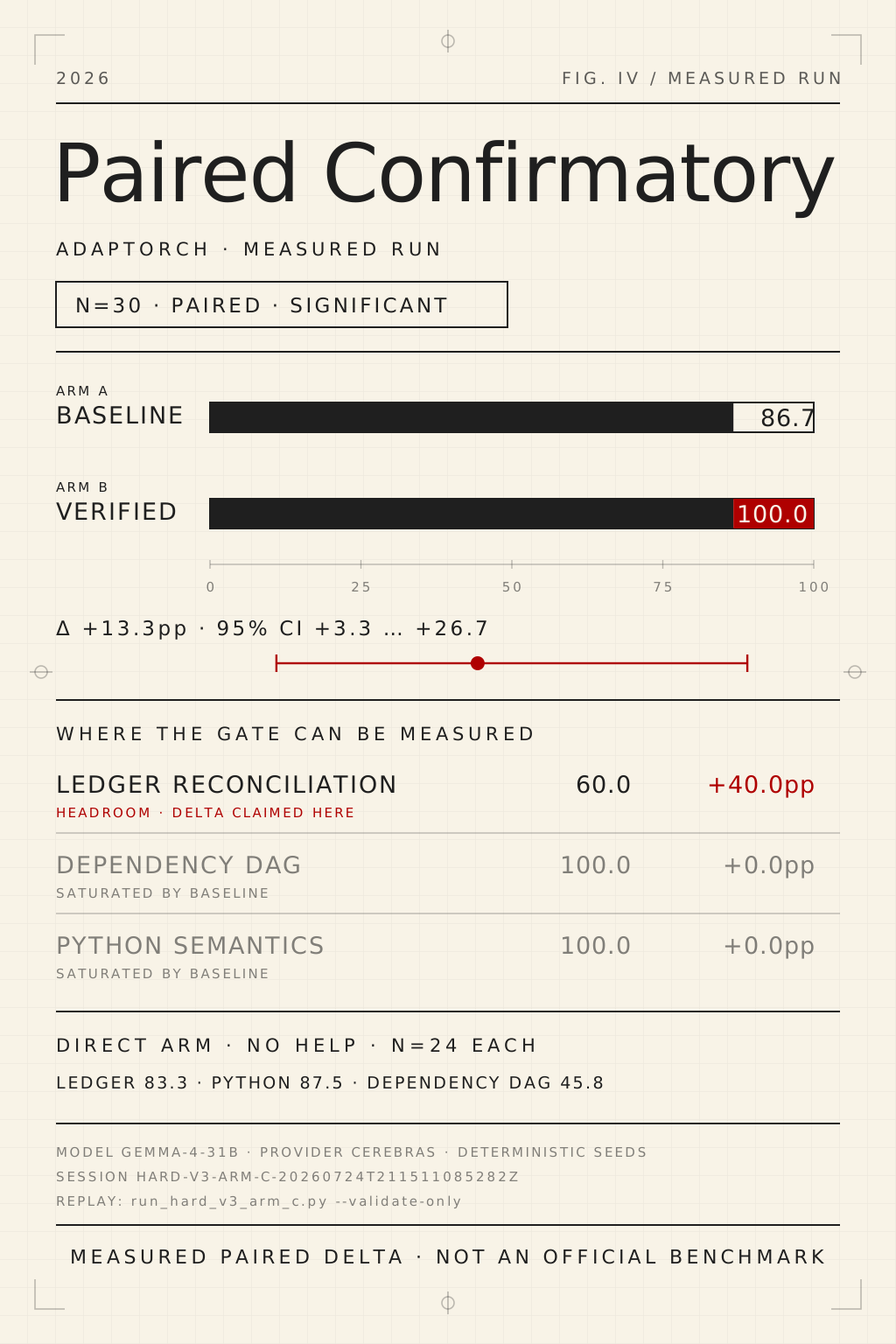
      paired_confirmatory_ledger: 30 synthetic ledger tasks, one paired session. Baseline 86.7%, verified 100.0%, difference +13.3pp (95% CI +3.3 to +26.7). The aggregate paired verdict did not reach significance and the family gate did not pass: directional, not proven. This is separate from the A/C ledger comparison.

      Measured paired run on 30 ledger tasks: baseline 86.7 percent, verified 100.0 percent, paired delta +13.3pp, 95 percent CI +3.3 to +26.7. The aggregate paired verdict did not reach significance and the family gate did not pass, so read this as directional, not proven. Two of three families saturated by baseline. Model gemma-4-31b on Cerebras, deterministic seeds.
      PLATE 00 · MEASURED — PAIRED CONFIRMATORY · OPEN FULL SIZE ↗
      FIG. VI · THE MAJORITY TRAP 20 puzzles · three models

      More models. Not a better result here.

      In this 20-puzzle ARC-AGI-2 run, the best single model scored 14/20 and the exact-answer vote scored 10/20. The vote cost more. This is one internal experiment, not a universal result.

      • 01Best single model: 14 correct out of 20
      • 02Exact-answer vote: 10 correct out of 20
      • 03Agreement alone does not establish correctness

      The published aggregates include errors and truncation counts. GPT scored 16 tasks with 4 errors; Qwen scored 19 with 1 truncation. Those denominators differ from the best-model and vote arms.

      Inspect the aggregate evidence JSON

      ARC-AGI-2 · 20 PUZZLES2026-08-26
      BEST ONE claude-opus-4-814 / 20 Recorded cost$16.91
      THE REST qwen3.7-max9 / 19 gpt-5.6-luna6 / 16
      ALL THREE majority vote10 / 20 Recorded cost$29.00
      VERDICT Higher cost. Lower score.

      Recorded model-call cost in USD, summed across the three member arms. Not a customer invoice or full TCO; additional charges are not established by this record.

      three-way-20260826T142538Z

      Public data contain aggregates, not per-task paired outcomes. They cannot independently establish how many answers were improved or regressed.

      n = 20 · descriptive aggregate comparison, not a general performance claim.

      FIG. X · WHAT WE DON’T CLAIM the honest part

      We cannot prove your code is right.

      A passing check covers only the conditions it executed. It does not establish overall correctness, safety, or behavior under untested conditions.

      A run receipt reports the evidence that was recorded. A run without executed verification is not a test pass. The local experiment above measures command checks; it does not establish hosted patch execution or developer time savings.

      We publish the negative outcomes too. In the synthetic ledger A/C comparison, eight task outcomes improved and one regressed. This compares both synthesis and verification settings, not the verifier alone.

      Read the formal claim boundary

      FIG. XI · FAQ claim boundaries first

      Questions about reviewing AI-generated code.

      If anything on this page promises more than we can show you, tell us. We will fix the page.

      Q.01What can I use in the hosted service today?

      Submit model-backed runs through MCP or the API and inspect their records, outputs and available artifacts. Shared hosted command verification is disabled by default; repository checks need a separate execution environment.

      Q.02Can you prove my code is correct?

      No general correctness proof is provided. Check which verification actually ran and what evidence was recorded. A successful model run without executed tests is not a test pass.

      Q.03Will it change what my AI does?

      The hosted workflow does not automatically apply or merge changes into your repository. A separately configured validation environment may apply a candidate in its agreed workspace for checking. You retain the review decision.

      Q.04How long does a check take?

      The current table reports local command-check timings on five fixed controls. Historical ledger timings measure a different operation. Neither establishes latency on your repository, hosted end-to-end latency, or saved developer time.

      Q.05What if the test fails because my machine is broken?

      Missing executables and timeouts were distinguished in the local controls. A missing Python dependency was classified as an ordinary test failure. Failure labels need context; they are not a guarantee that every environment problem is diagnosed.

      Q.06What does the monthly allowance count?

      One admitted run uses one allowance unit. Status, usage and artifact reads do not create a new run. Completion is not the counting trigger, and a separately admitted rerun counts again. Provider token charges are separate.

      Q.07Are model results and test results the same evidence?

      No. A model can finish without running a code check. Inspect the recorded commands, outcomes and skipped or untested areas. An AI-written explanation does not replace those records.

      Q.08Does it work with Claude Code, Cursor, or Codex?

      Use the documented MCP or HTTP connection path for your client. Authentication, a model run, and a repository check are separate steps; each needs its own confirmation.

      Q.09What is actually on the receipt?

      A report presents the execution record and whatever verification evidence is available. Changed files, before/after tests and rerun details depend on the configured path; missing checks must stay explicit.

      Q.10Can I run it on my own machine?

      The public Starter connects to hosted AdaptOrch. Running a client locally does not make the service self-hosted. Contact us about a separate private-runner deployment for your network.

      Q.11Is my private code safe?

      Hosted requests pass through AdaptOrch and the AI provider you configure. Review the data-transfer and retention policies before submitting private code. A private runner is a separate deployment, not a Starter default.

      Q.12When will it block a bad merge by itself?

      Automatic merging is not part of the default hosted offer. Any active gating must be separately configured and evaluated against the customer's own environment and review policy.

      Q.13What is AdaptOrch?

      AdaptOrch is a hosted service for reviewing AI agent run records, model outputs and available verification evidence. Connect your coding tools through MCP or the API. Repository checks require a separately configured execution environment.

      Q.14Where can I read the AdaptOrch research paper?

      The paper is “AdaptOrch: Task-Adaptive Multi-Agent Orchestration in the Era of LLM Performance Convergence” by Geunbin Yu, submitted to arXiv on 18 February 2026 as 2602.16873. Its research results are separate from the hosted product and the CEK repository-validation workflow.

      Read the AdaptOrch paper on arXiv →
      Q.15How do I verify AI-generated code before merging?

      Inspect the run record, not only the final answer. Check what actually ran, which commands or tests were recorded, whether a reproduction failed before and passed after, whether unrelated files changed, and whether the test itself changed. A passing check covers only what it executed; it is not a correctness guarantee.

      Q.16What is an agent run record?

      An agent run record is the stored history of one execution: the inputs, selected model, tool or command steps, outputs, status and available artifacts. AdaptOrch keeps hosted run records so a reviewer can inspect them later instead of relying on a chat transcript.

      Q.17Is AdaptOrch an AI code review tool?

      AdaptOrch is a review layer for AI coding agents, not another agent that writes code. It records execution evidence and available checks so a human can review the change. It complements code review and CI; it does not replace them or prove correctness.

      FIG. XII · BOOK DEMO audit first · merge later
      REPOSITORY VALIDATION POC

      Bring a review problem. Agree a useful evaluation.

      Tell us what is hard to verify. We will first check the execution constraints, then agree scope, deliverables and price before any repository work.

      • Keep your existing coding tools
      • Agree the repository and execution scope
      • Start with reporting, not automatic merging
      • Review useful findings, missed cases and setup cost
      • Free hosted Starter is a separate self-service option
      REQUESTSCOPED POC

      Do not submit source code, API keys or customer data. This enquiry does not execute work.

      Prefer email? ingeng2004@gmail.com

      LOG IN